We formalize the task of "In-situ Guide Grounding": a robot's ability to interpret symbols and text physically attached to objects.
📐 Formalization & Taxonomy
A new taxonomy of 5 in-situ guide information types that robots must interpret to act correctly.
🏆 New Benchmark Paradigm
First benchmark grounding visual guides into physical constraints — not just language instructions.
🗄️ Large-Scale Dataset
14k+ expert trajectories auto-generated via a scalable, procedural guide-to-physics pipeline.
🔬 VLA Model Analysis
Reveals critical visual grounding failures in $\pi_0$, GR00T N1.5, and SmolVLA across guide types.
TYPE 01
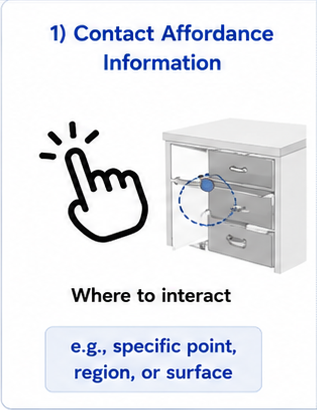
Identifies which part to interact with (e.g., a "PUSH" label pointing to a specific door panel).
TYPE 02
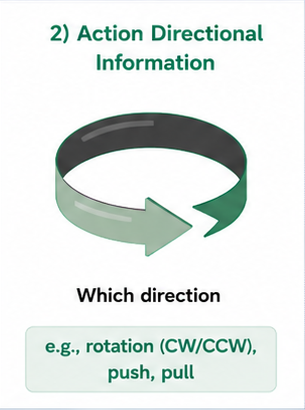
Constrains motion direction — e.g., CW/CCW arrows on a bottle cap or "PUSH"/"PULL" on a door.
TYPE 03
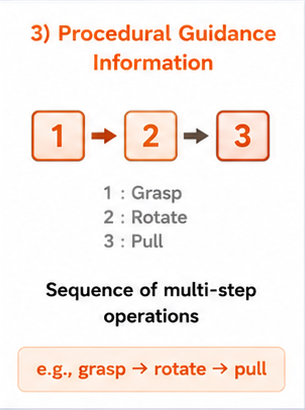
Defines the required action sequence — e.g., "Rotate handle, then Pull door."
TYPE 04
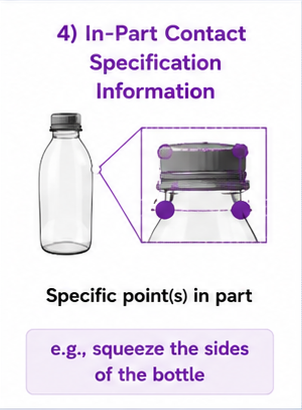
Specifies how to contact the part, e.g., squeeze arrows indicating exact pressure points on a child-proof cap.
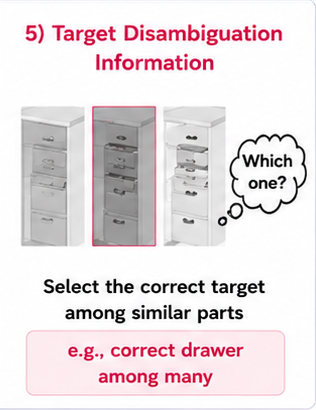
TYPE 05
Resolves which part to act on when multiple candidates exist — e.g., a marked drawer among several.
Cabinet Task
Select the correct handle from multiple candidates guided by an in-situ arrow.
Door Task
Rotate the handle in the correct direction, then push or pull the door.
Bottle-Standard Task
Open or close a bottle cap by rotating in the direction indicated by on-cap arrows.
Bottle-Squeeze Task
Squeeze the cap at marked pressure points, then rotate to unlock a child-proof bottle.
Over 14,000 expert trajectories across 4 task categories, procedurally generated and publicly available. Two guide placement variants (random / fixed position) with optional color augmentation.
Cabinet Dataset Visualization
Door Dataset Visualization
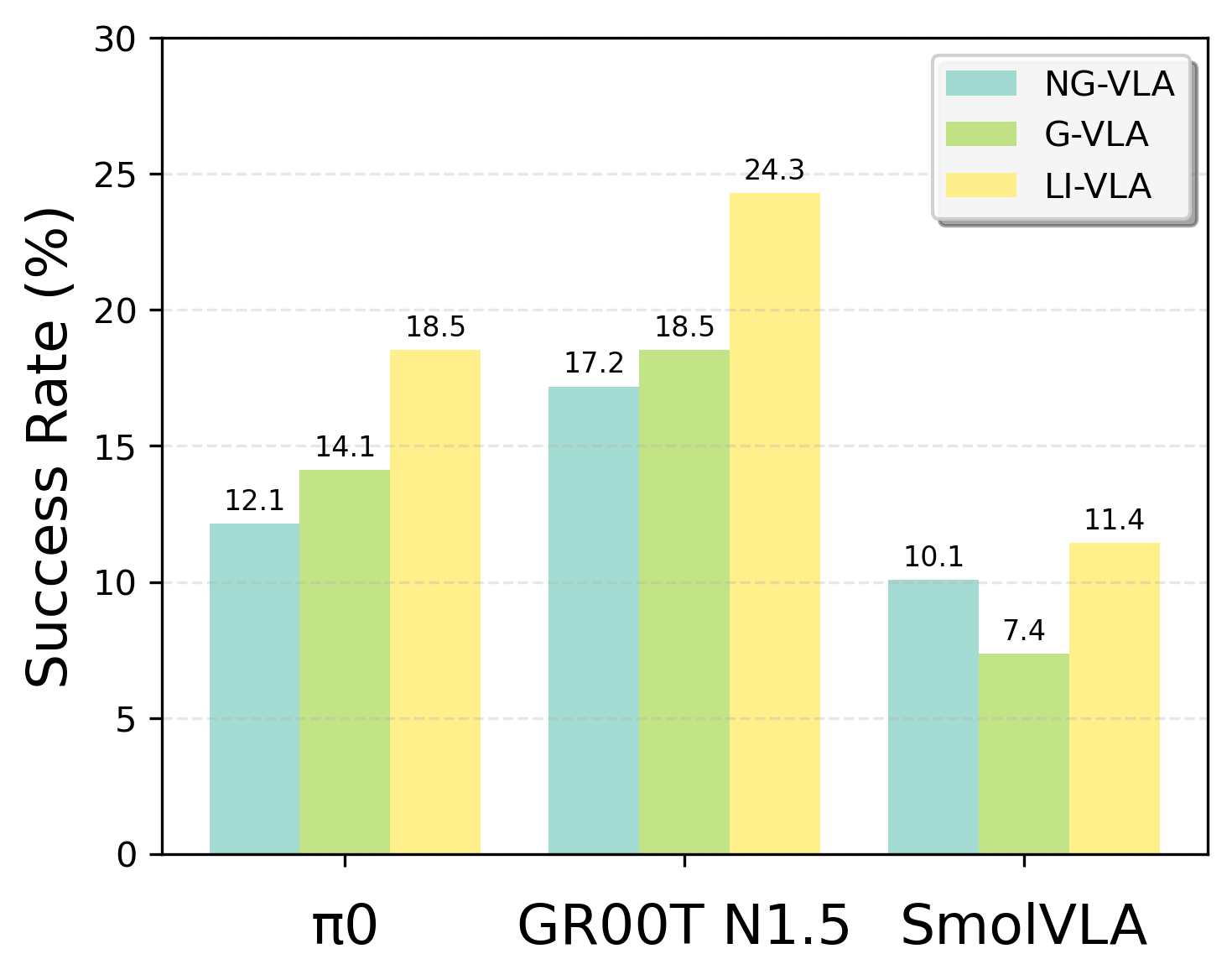
Overall performance comparison across recent VLA models including $\pi_0$, GR00T N1.5, and SmolVLA. Visual guides alone (G-VLA) yield only marginal gains, but adding language instructions (LI-VLA) boosts success rates by up to 24.3%.
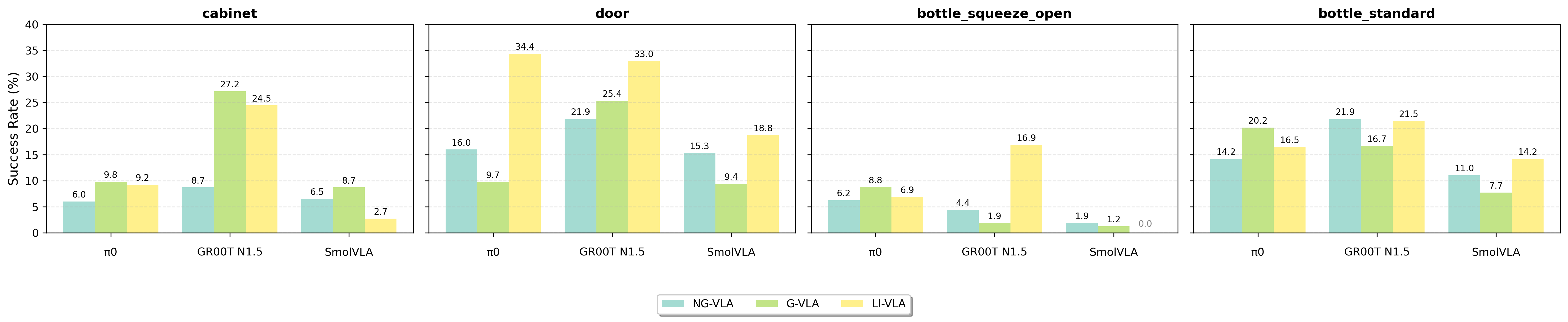
Detailed per-task success rates across all four task categories under three evaluation conditions (NG-VLA, G-VLA, LI-VLA).
Cabinet Left
Cabinet Right
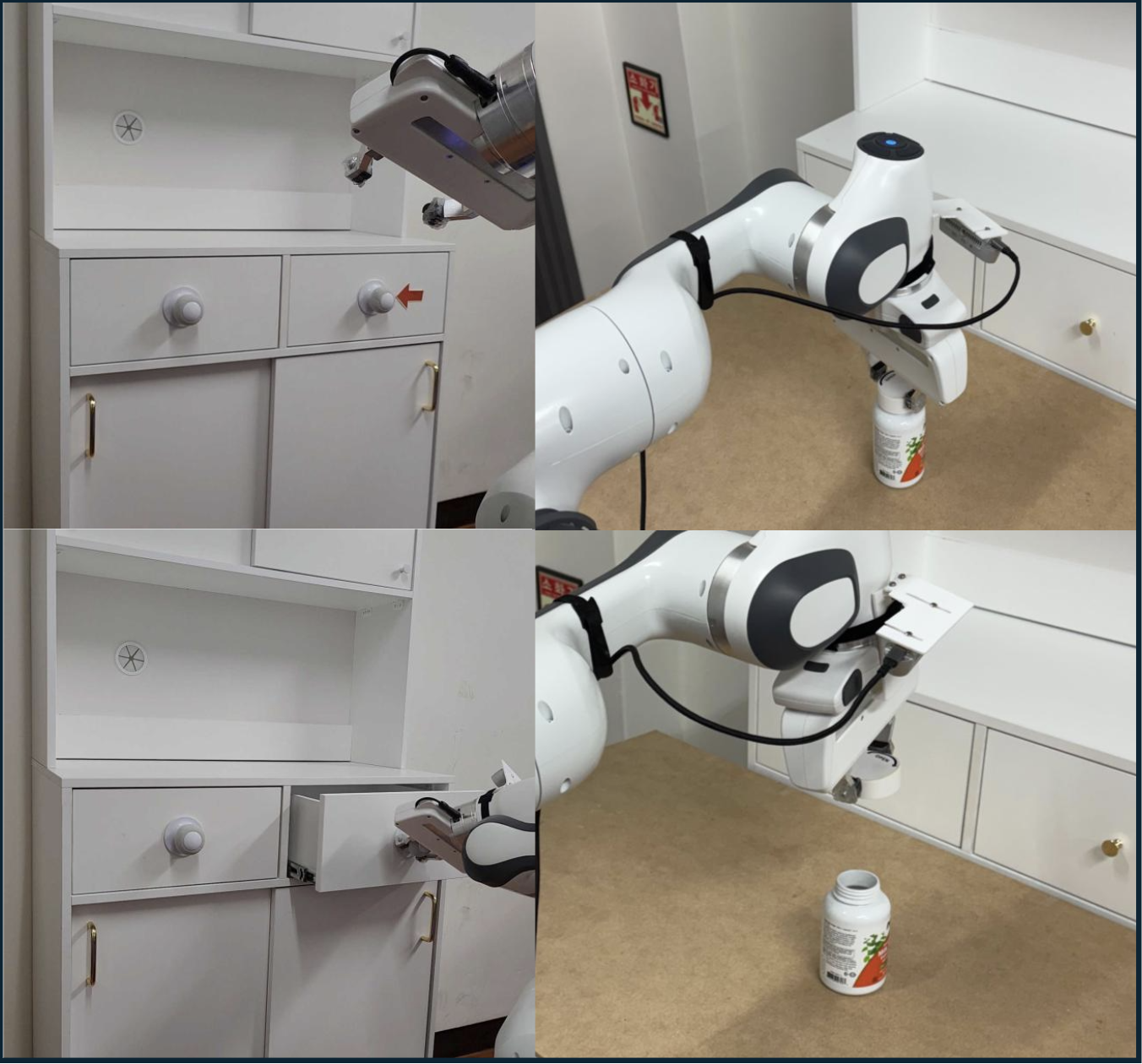
Real-world experimental setup with a 7-DoF robotic arm.
We validated our findings using a 7-DoF robotic arm. Simulation weights were fine-tuned via LoRA on a small real-world dataset (15 trajectories/task). The performance gap between visual-only (G-VLA) and language-instructed (LI-VLA) settings persists, confirming the challenge of interpreting embedded guides in the wild.
| Task | G-VLA | LI-VLA (Language) |
|---|---|---|
| Bottle-Standard Task | 45% | 65% |
| Cabinet Task | 45% | 50% |
Real-world success rates (10 trials per setting)
👁️
Perception Bottleneck
VLA models fail to ground directional and procedural guides from raw visual input alone.
💬
Language as a Proxy
Visual guides (G-VLA) consistently underperform language instructions (LI-VLA) — the bottleneck is perception, not the action policy.
⚠️
Visual Distraction
For smaller models, on-object guides act as visual distractors and can hurt performance.
@InProceedings{Kim_2026_CVPR,
author = {Kim, Seonho and Hong, Junhyeong and Lee, Kyungjae and Oh, Yoonseon},
title = {INSIGHT Bench: Towards Grounded IN-SItu Guidance for Robotic ManipulaTion},
booktitle = {Proceedings of the IEEE/CVF Conference on Computer Vision and Pattern Recognition (CVPR)},
month = {June},
year = {2026},
pages = {35070-35079}
}